

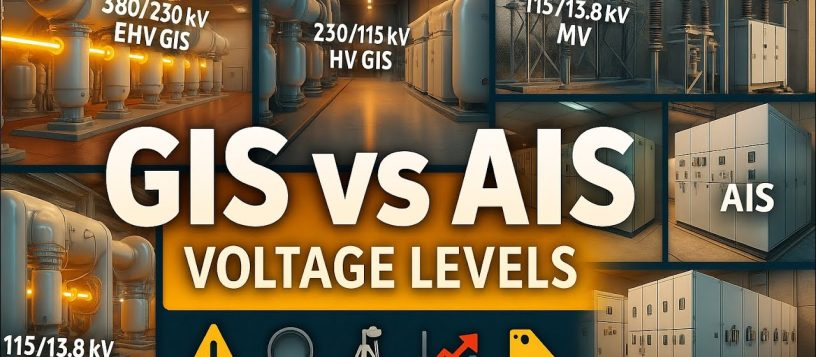
Choosing between Gas-Insulated Substations (GIS) and Air-Insulated Substations (AIS) is one of the most critical decisions in electrical infrastructure planning. In Saudi Arabia’s unique environmental and regulatory landscape, this choice impacts project costs, timelines, land utilization, and long-term operational efficiency.
Understanding GIS and AIS Technologies
Air-Insulated Substations (AIS)
Traditional outdoor substations where conductors and equipment are separated by air as the insulating medium.
Advantages:
- Lower initial capital cost
- Simpler technology with proven track record
- Easier visual inspection and maintenance
- Wider availability of spare parts
- Suitable for areas with ample land availability
Disadvantages:
- Larger footprint (requires 5-10x more space than GIS)
- Vulnerable to environmental contamination (dust, sand, salt)
- Higher maintenance requirements in harsh climates
- Greater exposure to weather-related outages
- Longer installation timelines
Gas-Insulated Substations (GIS)
Compact substations using sulfur hexafluoride (SF6) gas as the insulating medium in sealed metal enclosures.
Advantages:
- Compact design (90% smaller footprint than AIS)
- Superior performance in dusty, humid, or coastal environments
- Reduced maintenance requirements
- Faster installation and commissioning
- Enhanced reliability and availability (>99.9%)
- Better aesthetics for urban installations
- Lower lifecycle costs in harsh environments
Disadvantages:
- Higher initial capital investment (20-40% more than AIS)
- Requires specialized training for maintenance
- SF6 gas handling requires environmental precautions
- Longer lead times for equipment procurement
- Complex fault location and repair
Saudi Arabia-Specific Considerations
When to Choose GIS:
✓ Urban Areas: Limited land availability in cities like Riyadh, Jeddah, Dammam ✓ Coastal Installations: High humidity and salt exposure in Al Jubail, Yanbu, Ras Tanura ✓ Industrial Facilities: ARAMCO, SABIC, and petrochemical plants requiring maximum reliability ✓ Dust-Prone Regions: Areas with frequent sandstorms requiring sealed equipment ✓ Critical Infrastructure: Data centers, hospitals, airports requiring uninterrupted power ✓ Aesthetic Requirements: Visible installations in commercial or residential areas
When to Choose AIS:
✓ Rural Locations: Abundant land availability at lower cost ✓ Budget Constraints: Limited capital expenditure with acceptable operational costs ✓ Standard Applications: Non-critical distribution networks ✓ Easy Access Sites: Locations with straightforward maintenance access ✓ Lower Voltage Levels: 13.8kV to 33kV distribution substations ✓ Temporary Installations: Construction sites or interim power solutions
Installation Process Comparison
GIS Substation Installation Timeline: 12-18 weeks
Phase 1: Foundation & Civil Works (4-6 weeks)
- Precision foundation requirements (±2mm tolerance)
- Indoor building construction or weatherproof enclosure
- HVAC system installation for temperature control
- Fire suppression system installation
Phase 2: Equipment Delivery & Inspection (2-3 weeks)
- Factory acceptance testing verification
- SF6 gas quality verification
- Component inspection and documentation
- Storage in controlled environment
Phase 3: Assembly & Installation (4-6 weeks)
- Module positioning and alignment
- Busbar connections and sealing
- Control cable installation
- SF6 gas filling and pressure testing
- Leak detection testing
Phase 4: Testing & Commissioning (2-3 weeks)
- Primary and secondary injection testing
- Protection relay calibration
- SCADA integration and communication testing
- Partial discharge testing
- Final energization and load testing
AIS Substation Installation Timeline: 16-24 weeks
Phase 1: Foundation & Civil Works (6-8 weeks)
- Equipment foundations and cable trenches
- Gravel surfacing and drainage systems
- Lightning protection and grounding grid
- Security fencing and access roads
Phase 2: Equipment Delivery & Inspection (2-3 weeks)
- Transformer delivery and positioning
- Circuit breaker and disconnect switch inspection
- Insulator and busbar verification
- Control panel and relay testing
Phase 3: Assembly & Installation (6-10 weeks)
- Transformer installation and oil filling
- Busbar stringing and termination
- Cable pulling and termination
- Control wiring and interconnections
- Grounding system connections
Phase 4: Testing & Commissioning (2-3 weeks)
- Insulation resistance testing
- Contact resistance measurement
- Protection system verification
- Phasing and polarity checks
- Load testing and handover
Cost Analysis: GIS vs AIS in Saudi Arabia
Initial Capital Costs (132kV Substation, 2×40 MVA)
| Cost Component | AIS (SAR) | GIS (SAR) | Difference |
|---|---|---|---|
| Equipment | 8-10 million | 12-15 million | +40-50% |
| Civil Works | 3-4 million | 1.5-2 million | -50% |
| Installation | 1.5-2 million | 1-1.5 million | -33% |
| Land Acquisition | 2-5 million* | 0.5-1 million* | -75% |
| Total | 14.5-21M | 15-19.5M | Variable |
*Land costs vary significantly by location (urban vs. rural)
Lifecycle Cost Comparison (25-year period)
| Cost Factor | AIS | GIS |
|---|---|---|
| Maintenance | High (annual inspections, cleaning) | Low (5-year intervals) |
| Outage Costs | Higher (weather-related) | Minimal |
| Replacement Parts | Readily available, lower cost | Specialized, higher cost |
| Energy Losses | Slightly higher | Lower |
| Total Lifecycle Cost | Baseline | 10-15% lower in harsh environments |
Environmental & Regulatory Compliance
SF6 Gas Regulations in Saudi Arabia:
- SF6 is a potent greenhouse gas (23,500x CO2 equivalent)
- Saudi environmental regulations require:
- Certified SF6 handling personnel
- Gas recovery and recycling equipment
- Leak detection and reporting
- Proper disposal procedures
- Documentation for all gas transactions
Gridtech’s SF6 Management:
- Certified technicians with international training
- Zero-emission gas handling procedures
- SF6 recovery and purification systems
- Complete documentation for regulatory compliance
- Partnership with approved SF6 suppliers
Technical Specifications Comparison
132kV Substation: Key Parameters
| Parameter | AIS | GIS |
|---|---|---|
| Footprint | 3,000-5,000 m² | 300-500 m² |
| Installation Time | 16-24 weeks | 12-18 weeks |
| Maintenance Interval | 6-12 months | 3-5 years |
| Expected Lifespan | 30-40 years | 40-50 years |
| Availability | 98-99% | 99.9%+ |
| Short Circuit Rating | 31.5-40 kA | 40-50 kA |
| Pollution Level | Requires regular cleaning | Sealed, protected |
Hybrid Solutions: Best of Both Worlds
For some Saudi Arabian projects, hybrid configurations offer optimal solutions:
Hybrid Configuration Examples:
Option 1: GIS for High Voltage, AIS for Distribution
- 132kV or 380kV GIS switchgear
- 13.8kV AIS switchgear for distribution
- Balances cost and space efficiency
Option 2: Indoor AIS
- AIS equipment in climate-controlled buildings
- Protects against dust and humidity
- Lower cost than GIS with better protection than outdoor AIS
Gridtech Experts Engineering: Your Substation Installation Partner
Our Capabilities:
- Voltage Levels: 13.8kV to 380kV GIS and AIS installations
- Certifications: SEC, ARAMCO, SABIC vendor approvals
- Standards Compliance: IEC 62271, IEEE C37, SAES standards
- Geographic Coverage: All regions of Saudi Arabia
- Project Types: Greenfield, brownfield, upgrades, expansions
Our Value Proposition: ✓ Experienced Engineers: 10+ years average experience in substation installation ✓ Safety Record: Zero-incident commitment with comprehensive HSE programs ✓ Quality Assurance: ISO-compliant procedures with documented inspections ✓ Timely Delivery: Proven track record of on-schedule project completion ✓ Technical Support: Post-commissioning O&M services and 24/7 support
Recent Projects:
- 132kV GIS substation installation for industrial facility in Al Jubail
- 380kV AIS expansion for transmission network upgrade
- 33kV indoor substation for commercial development in Riyadh
- Emergency substation replacement and commissioning
Conclusion
The choice between GIS and AIS substations depends on multiple factors: land availability, environmental conditions, budget constraints, reliability requirements, and lifecycle cost considerations. In Saudi Arabia’s challenging climate and with stringent regulatory requirements, expert guidance is essential.
At Gridtech Experts Engineering, we provide unbiased technical consultations to help you select the optimal substation technology for your specific needs. Our installation teams deliver both GIS and AIS projects with the same commitment to safety, quality, and client satisfaction.
Contact us today for a free consultation on your substation installation project.
